Agentic NURBS Geometry
An agentic LLM framework that turns static models and natural-language intent into parametric Grasshopper scripts — presented at AAG 2025, MIT.
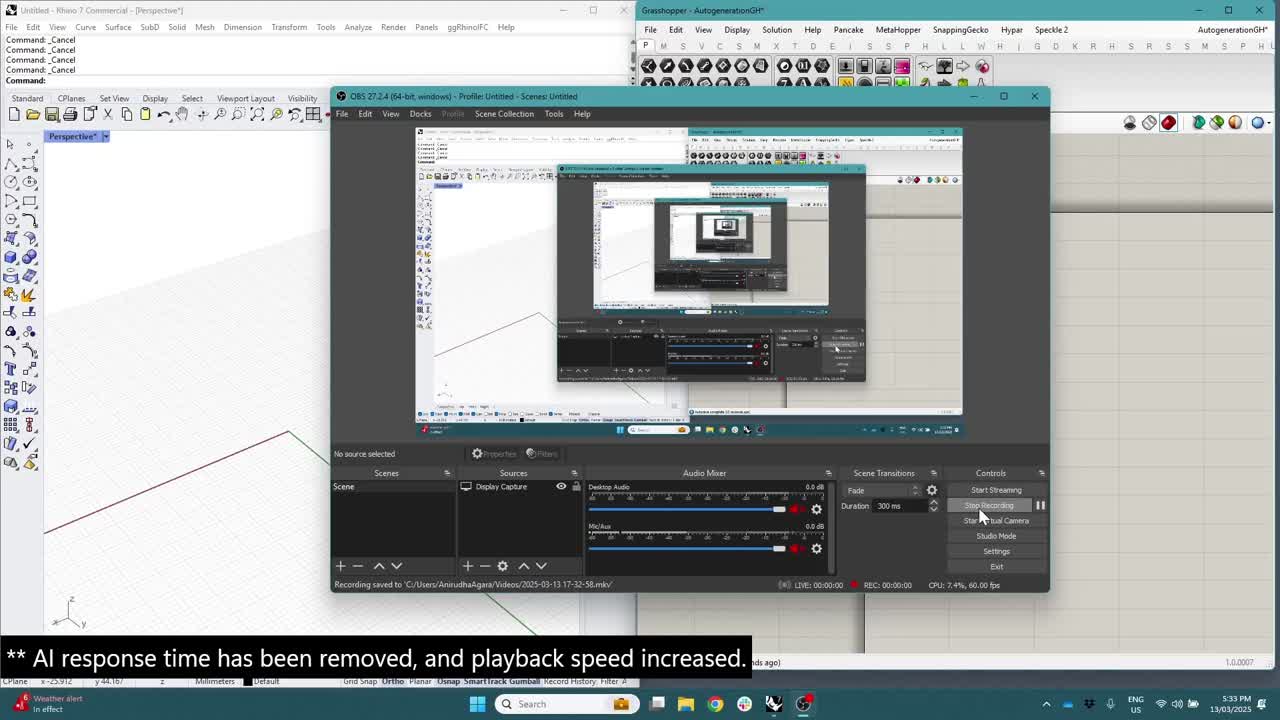
Presented at Advances in Architectural Geometry 2025, Massachusetts Institute of Technology, Boston.
The research develops an agentic large-language-model framework for parametric NURBS geometry generation in computational design. Large language models automate Grasshopper script creation so precise, manufacturable digital models become easier to produce across design teams. Natural-language intent is parsed into parametric design logic — compressing the distance between design intent and editable geometric structure, without replacing computational literacy.
Supported by PT Blink. Full paper ↗ · AAG 2025 ↗
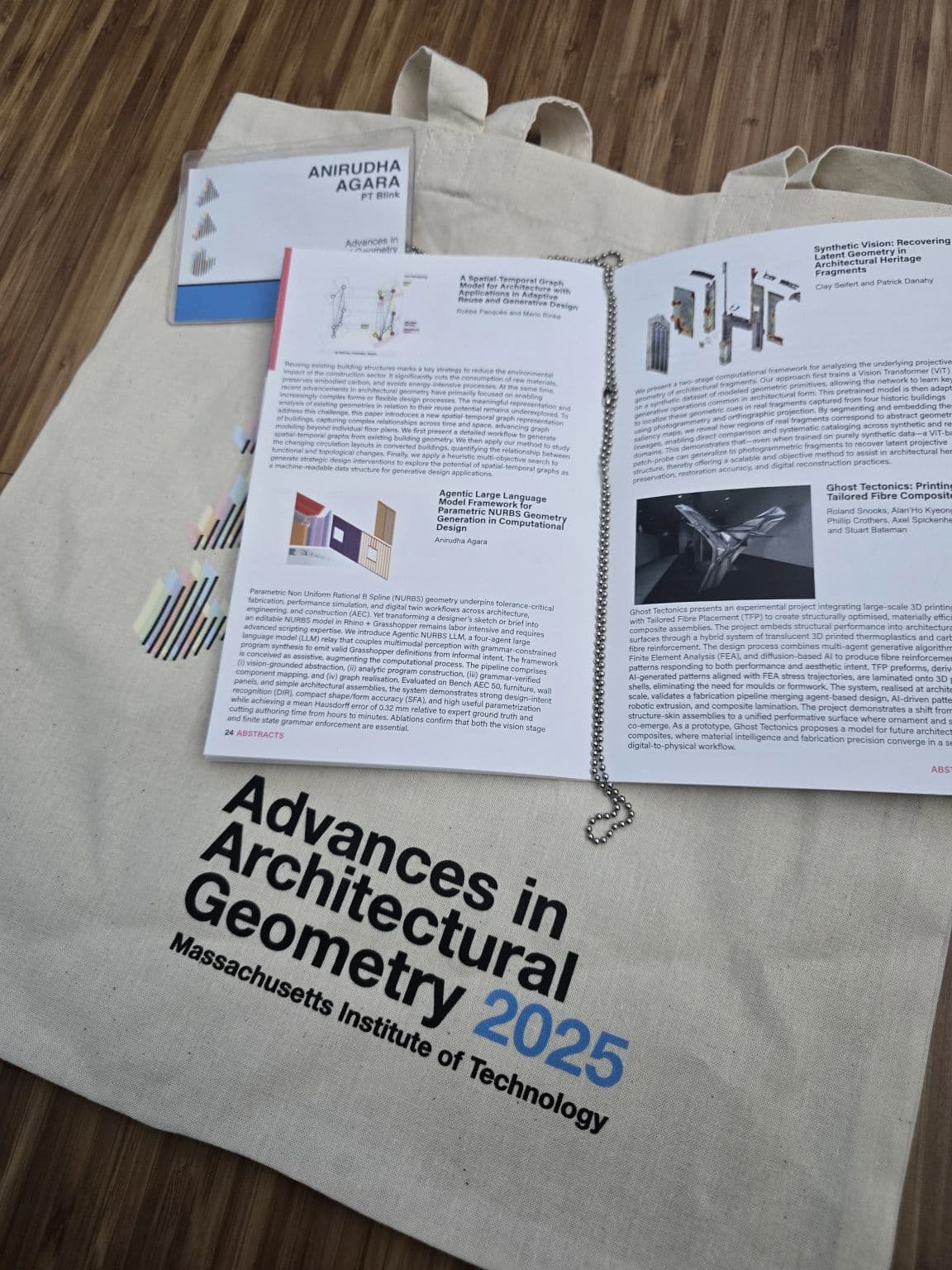
From static model to editable script
Upstream of the formal framework: can any static 3D model become a fully parametric Grasshopper definition without hand-authoring the graph?
Early attempts trained an LLM to emit complete .ghx XML and hit scalability limits. The approach shifted to a structured JSON intermediate — modular component generation inspired by graph-based Grasshopper workflows — then reconstitution into an interactive definition with sliders and custom inputs.
- Input — a static 3D model or sketch
- Multi-angle capture — geometric data extracted with computer vision
- Contextualisation — recognised parts mapped into the Rhino / Grasshopper environment
- Component data — structured JSON drawn from a Grasshopper component database
- Script generation — JSON converted into an interactive Grasshopper definition
Open questions remain around generation cost, complex geometry, reuse of existing canvas logic, and script readability.